1- Origin of the Rosary
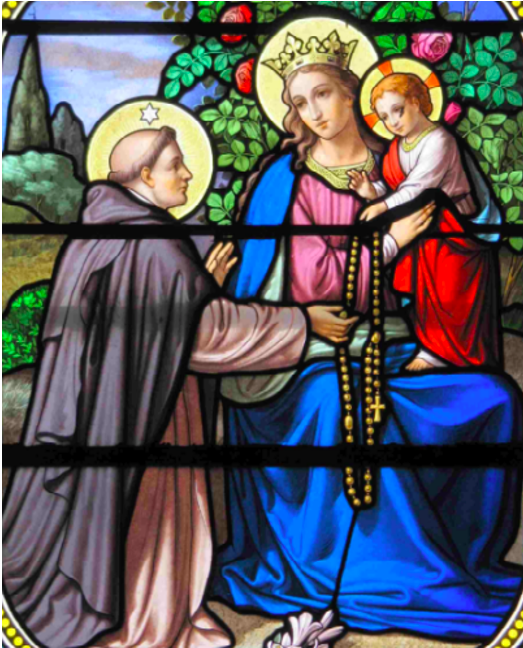
"The Rosary was instituted under divine inspiration by Saint Dominic". [1170-1221]
Pope Leo XIII, Supremi Apostolatus Officio, 1er august 1883.
Numerous historical facts attest to this. Queen Blanche of Castile, having failed to bear children after twelve years of marriage, was visited in 1212 by St. Dominic, who advised her to recite a prayer then unknown: the Rosary. She followed his advice, had rosaries made and distributed, and in 1214 gave birth to the future Saint Louis. This good King was the first to recite the Rosary daily.
Subsequently, numerous popes attested to the origin of the Rosary, leading to Benedict XIV (1740 - 1758) to write: "... so many oracles from sovereign pontiffs, from Leo X, Pius V, Gregory XIII, Sixtus V, Clement VIII, Alexander VII, Innocent XI, Clement XI, Innocent XIII, Benedict XIII and others, all unanimous in attributing to Saint Dominic the institution of the Rosary...".
2- Structure of the Rosary in three beads
2-1 The unanimous teaching of the popes
Urban IV
In 1236 he wrote: " It is a pious rite according to which, against the dangers facing the world, one recites the Ave Maria as many times as there are psalms of David, [150 ed.], preceding each decade with the Sunday Oration. With our apostolic authoritý, we approve this psalter of the Virgin. "
Saint Pius V
In 1569, he definitively fixed the form of the Rosary with the bull Consueverunt romani Pontifices, in which he clearly states that Saint Dominic brought it to the Church " ... a mode of prayer, called́ Rosary or psalter of the Blessed Virgin Mary, which consists in honoring the Blessed Virgin Mary by reciting 150 Ave MariaIn accordance with the number of the psalms of David, adding to each ten Ave, the Sunday prayer and meditation on the mysteries of the life of Our Lord Jesus Christ.
Leo XIII
In Lætitiæ sanctæ (August 8, 1893) that " three the main causes of people's disorder find their remedies in the three series of mysteries."
Paul VI
At the time of the Second Vatican Council, detractors wanted to modify the Rosary and Paul VI emphatically refused :
1973 " The rosary must remain unique in form and unchanged than it is today. "
2-2 John Paul II's apostolic letter
In 2002, John Paul II signed a apostolic letter Rosarium Virginis Mariae. Many confusions have been made about this letter of the pope and it is useful to recall several important things:
- It does not create any obligation because a apostolic letter is a matter for the free appreciation of the faithful. and he reminds us of this in his letter.
- visit Joyful Mysteries concernent la vie du Christ de son Incarnation jusqu’à l’institution de l’Eucharistie. La tradition nous a apporté les cinq mystères que nous connaissons, portant sur le vie cachée de Jésus, mais l’Église ne les a jamais figés. Des prédicateurs, dans les siècles passés, ont fait des méditations sur d’autres passages de la vie de Notre Seigneur.
- Les thèmes des mystères n’étant pas figés, Jean Paul II a suivi cette pratique et a proposé de méditer des passages de la vie publique de Jésus les appelant “lumineux” pour les distinguer des mystères de la vie cachés de Jésus.
- He never indicated that the structure of the Rosary had changed and that 200 "Hail Marys" had to be said. Proof of this is that he did not change the structure of the Rosary in the official repertory published by the Holy See, The Enchiridion Indulgentiarum in which the 15-tens structure is retained.
The faithful are therefore free to ignore these mysteries, or to meditate on them in the Joyful Mysteries, or to make a separate rosary during the week with these themes, or even to choose other passages from the life of Jesus.
2-3 Fatima: the great confirmation of the structure of the Rosary by the Blessed Virgin herself
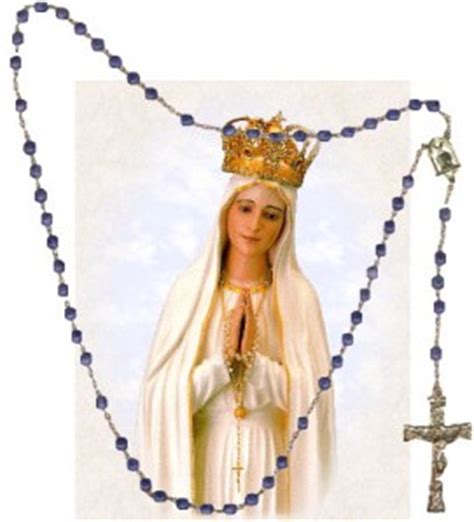
On October 13, 1917, after saying that his name was Our Lady of the Rosarythe Blessed Virgin showed the little visionaries three pictures representing the three series of the mysteries of the Rosary:
- the Holy Family, illustrating joyful mysteries ;
- Our Lady of Sorrows, with Our Lord beside her, illustrating the painful mysteries ;
- Our Lady of Mount Carmel holding a scapular in her hand, illustrating the glorious mysteries.
Then, on December 10 1925, Our Lady confirmed the structure of the Rosary. In her apparition to Sister Lucia of Fatima on the "1st Saturday of the month", she asked her listeners to meditate for fifteen minutes on the "Rosary". on the fifteen mysteries of the Rosary in the spirit of reparation".
2-4 The new "rosary" prayers
Over the past few years, new prayers have been appearing under the name of "rosaries" (for example, the Misericordia rosary). The term used is also "rosary", which can lead to confusion.
A clear distinction must be made between Rosary beads demandé à Fatima avec ces nouveaux “chapelets” qui sont sans liens avec Fatima. A Fatima, la Saint Vierge a bien demandé exclusivement la récitation Rosary beads especially on the 1st Saturday of the month.
3- Synthesis of the spiritual meaning of the three Rosary beads
The meaning of the Rosary's structure is incredibly logical and has many aspects. These include:
- The three rosaries are in honor of the three persons of the Holy Trinity.
- They are a meditation on the three mysteries of salvation: incarnation, redemption and eternal life.
- They illustrate the three states of the Church: Joyful Mysteries / Church militant, Sorrowful Mysteries / Church suffering, Glorious Mysteries / Church triumphant.
- They are composed of 150 "Hail Marys", like the 150 psalms of David; these psalms are part of the priests' breviary, and the Rosary is thus a kind of breviary for the faithful.
- Between the 1era apparition at Fatima (May 13, 17) and the last (Oct. 13, 17) exactly 150 days ago.
Conclusion
The Rosary, composed of 150 "Hail Marys" divided into three rosaries, given to Saint Dominic in the 13th century.ème century was confirmed by popes and the Blessed Virgin herself at Fatima. Its structure in 150 "Hail Marys" has never been changed by Heaven or the Church. At Fatima, Our Lady asked for meditation on the "Hail Marys". fifteen mysteries of the Rosary "We must therefore faithfully respect his request.